

Meeting Singapore entry requirements 2026 requires a passport valid for at least six months from arrival, a completed SG Arrival Card (SGAC) submitted within three days before arrival, and compliance with customs and immigration rules. US, UK, Australian, and Canadian passport holders enter visa-free for up to 90 days. The Immigration & Checkpoints Authority (ICA) and Singapore Customs oversee all entry procedures, including mandatory biometric enrollment (iris, fingerprint, facial scans) for first-time visitors.
Last updated: August 2026. This guide reflects current regulations published by the ICA and Singapore Customs. Immigration policies may change without prior notice. Verify all requirements directly via the ICA website before travel.
Passport and Visa Requirements by Nationality
All non-Singaporean travelers must hold a passport valid for at least six months from the date of arrival to meet Singapore entry requirements 2026. Singapore citizens and Permanent Residents face no minimum passport validity restriction. Short-term visitors should carry proof of onward travel, proof of accommodation, and evidence of sufficient funds, as immigration officers may request these at the checkpoint.
Visa-Free Access vs. Visa Required
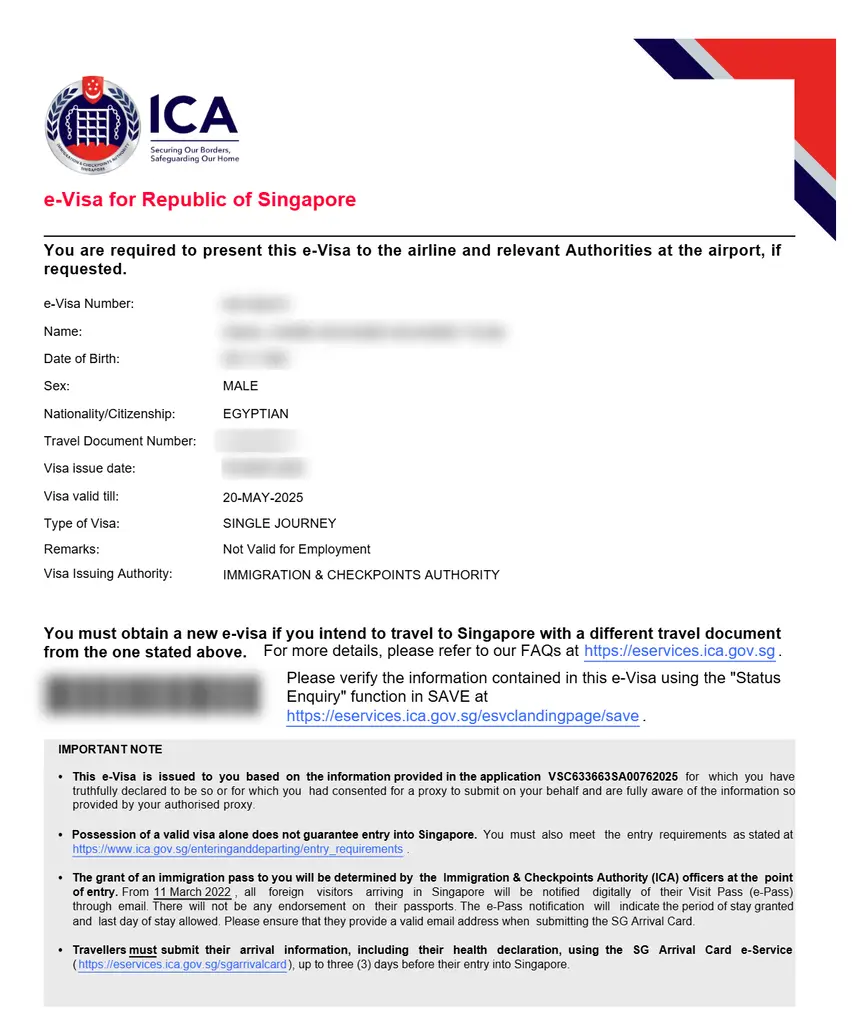
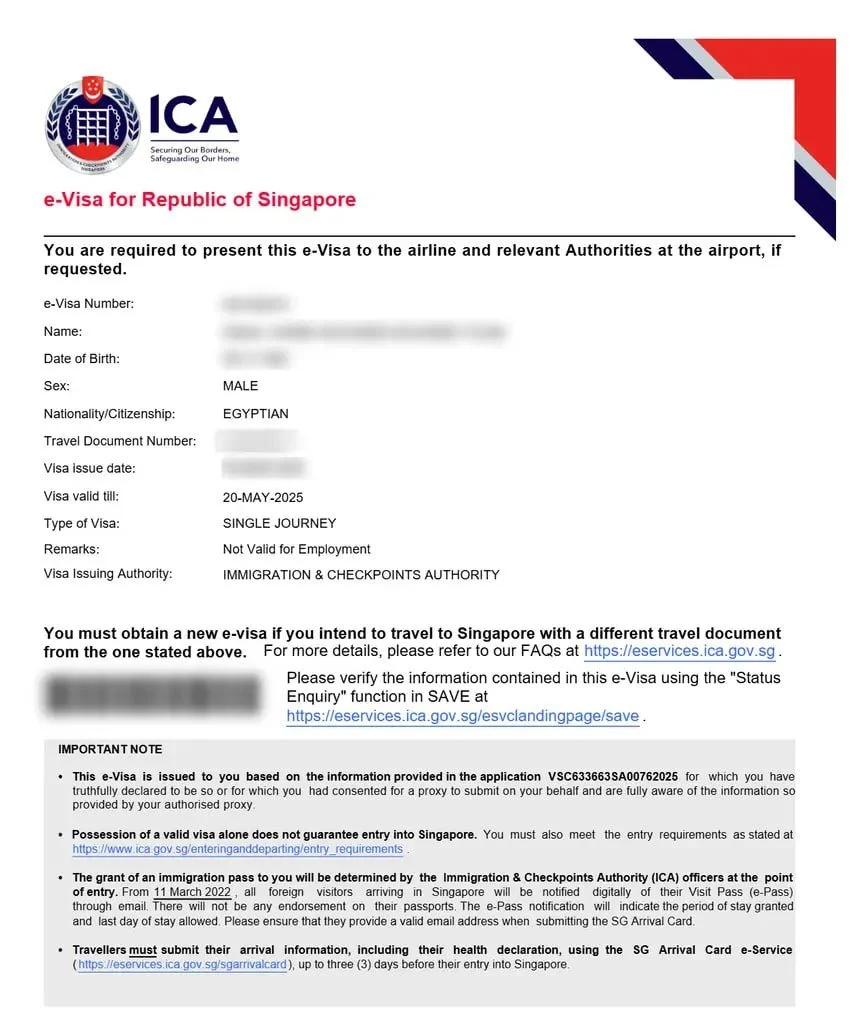
Singapore entry requirements 2026 grant visa-free entry to eligible nationalities, while others must secure a visa via the ICA. Understanding the difference between the SGAC and a visa helps travelers prepare the correct documentation before arrival. Standard visa application fees range from S$30 to S$90. Eligible transiting passengers may use the Visa-Free Transit Facility (VFTF) with a confirmed onward ticket departing within 96 hours.
| Nationality Category | Maximum Stay and Conditions |
|---|---|
| US, UK, Australian, and Canadian citizens | Visa-free entry for up to 90 days. |
| Visa-Required Nationalities | Must apply prior to arrival. Verify status via the ICA country list. |
SG Arrival Card (SGAC) and Health Declarations
Singapore entry requirements 2026 mandate that every traveler submit the free SG Arrival Card (SGAC) online within three days before arrival, including the day of arrival. The SGAC is a mandatory digital health and travel declaration, replacing the former paper Disembarkation/Embarkation (DE) card. Failure to submit may result in entry denial.
How to Submit the SGAC
Submit via the ICA SGAC e-Service (browser) or the MyICA Mobile app. The process is free of charge and takes under 10 minutes:
- Access the platform within three days before entry, including arrival day.
- Enter your passport number, nationality, and date of birth.
- Provide your full Singapore accommodation address (block/unit, street, postal code, not just the hotel name).
- Complete the health declaration section (fever, respiratory symptoms, recent travel to outbreak areas).
- Review all fields and submit. Save or screenshot the confirmation for immigration.
Common errors: “Application not found” typically indicates the submission falls outside the 3-day window. Incorrect passport numbers cannot be edited after submission; contact the ICA helpdesk via the e-Service portal or resubmit. Families can use the group submission feature on the MyICA Mobile app.
SGAC Exemptions
The following travelers do not need to submit an SGAC:
- Transit or transferring passengers not seeking immigration clearance
- Singapore citizens, PRs, and Long-Term Pass holders entering via land checkpoints (Woodlands, Tuas)
For the full list of who is exempt, see our detailed guide on SGAC exemptions.
COVID-19 and Yellow Fever Rules in 2026
As of 2026, Singapore entry requirements 2026 include no pre-arrival COVID-19 testing or vaccination. A basic health declaration is part of the SGAC. Travelers arriving from or transiting through yellow fever risk countries within the past six days must present a valid yellow fever vaccination certificate. Travel insurance is not legally mandatory but strongly recommended due to Singapore’s high healthcare costs.
Immigration Clearance and Entry Points
Singapore entry requirements 2026 require first-time visitors to complete biometric enrollment at immigration. All approved travelers receive a digital e-Pass instead of a physical passport stamp.
Biometric Enrollment and the e-Pass
Officers collect iris, fingerprint, and facial biometrics from first-time visitors. Returning travelers typically undergo facial scan and one fingerprint. After clearance, the short-term Visit Pass system issues an e-Pass to the email declared in the SGAC, containing the Visit Pass number, permitted stay duration, and expiry date. Check status via the SGAC submission status page if not received within 24 hours.
Practical note: First-time visitors should allow extra time at immigration for biometric enrollment, especially at Changi Airport during peak hours.
Arriving by Air, Land, or Sea
Singapore entry requirements 2026 vary by arrival mode. Air travelers at Changi Airport use automated clearance lanes for SGAC holders. Drivers entering via the Woodlands or Tuas land checkpoints must secure a VEP (Vehicle Entry Permit) and Autopass for foreign-registered vehicles — review the overland entry SGAC requirements for a full checklist. Cruise and ferry arrivals follow a process similar to air entry. Private vessels require prior notification to the Maritime and Port Authority (MPA).
Customs Declarations and Duty-Free Allowances
Travelers must declare all goods exceeding duty-free limits and any cash or bearer instruments (CBNI) exceeding S$20,000. Singapore entry requirements 2026 require pre-arrival goods declarations via the Customs@SG web application.
Duty-Free Allowances
- Alcohol: Returning residents absent at least 48 hours with minimum S$100 in purchases qualify for 1L spirits, 1L wine, and 1L beer. Visitors pay duty on all alcohol.
- Tobacco: Duty applies to ALL tobacco products with a zero duty-free allowance.
- General goods: Up to S$500 per person for travelers arriving by air.
Declaring Cash (CBNI) Over S$20,000
Travelers carrying Cash and Bearer Negotiable Instruments (CBNI) exceeding S$20,000 (or foreign currency equivalent) must submit a full declaration at the Red Channel upon arrival. These customs obligations are a core part of Singapore entry requirements 2026.
Prohibited and Restricted Items
Singapore entry requirements 2026 prohibit the import of drugs, chewing gum, and vaping devices, with severe legal consequences. When in doubt, declare at the Red Channel; undeclared items carry heavier penalties than declared excess.
| Item | Penalty | Relevant Law |
|---|---|---|
| Drugs (e.g., ≥15g heroin) | Death penalty | Misuse of Drugs Act |
| Vaping devices | Fine up to S$1,000 | Tobacco Act |
| Chewing gum | Fine up to S$2,000 | Public Health Act |
| Firecrackers, obscene materials | Confiscation and fines | Various statutes |
Items Requiring a Permit
Understanding Singapore entry requirements 2026 for controlled goods means obtaining prior approval: weapons (Arms Offences Act, imprisonment), psychotropics and codeine-based medications (Health Sciences Authority permit), wildlife products (CITES), and telecommunications equipment (IMDA).
Extended Stay, Work Visas & Long-Term Entry
Standard visa-free visitors may stay up to 90 days. Singapore entry requirements 2026 allow Visit Pass extensions through the ICA e-Service before the current pass expires, though approval depends on the stated purpose and is not guaranteed.
Work Passes and Long-Term Entry
Singapore entry requirements 2026 for long-term stays include the following pass categories:
| Pass Type | Purpose | Key Requirement |
|---|---|---|
| Employment Pass | Professionals earning ≥S$5,000/month | Employer-sponsored application |
| S Pass | Mid-skilled workers earning ≥S$3,150/month | Employer-sponsored; quota limits apply |
| Work Permit | Construction, manufacturing, domestic workers | Sector-specific; employer-sponsored |
| Student Pass | Full-time study at approved institutions | Institution must be ICA-approved |
| Dependant’s Pass | Family members of Employment/S Pass holders | Sponsor must hold valid EP or S Pass |
Penalties for Non-Compliance and Overstaying
Violating Singapore entry requirements 2026 can result in fines up to S$1,000, imprisonment up to 3 months, and mandatory caning for severe offenses. Full details on fines and legal consequences are covered in our SGAC penalties guide.
Overstaying Your Visit Pass
Under the Immigration Act, overstaying triggers:
- Fine: S$100 per day or part thereof, capped at S$1,000
- Imprisonment: up to 3 months
- Caning: mandatory minimum 3 strokes for overstays exceeding 90 days
- Future entry ban and difficulty obtaining visas to other countries
Action item: Set a reminder 7 days before your Visit Pass expiry date.
Penalties for Prohibited Items
Key statutes enforcing Singapore entry requirements 2026 on prohibited goods: Misuse of Drugs Act (death penalty for drug trafficking above statutory thresholds), Tobacco Act (up to S$1,000 for vaping), Public Health Act (up to S$2,000 for chewing gum), Arms Offences Act (imprisonment for weapons).
Frequently Asked Questions About Singapore Entry Requirements 2026 (FAQ)
What items are strictly prohibited when entering Singapore?
Drugs carry the death penalty above certain thresholds (≥15g heroin, ≥500g cannabis, ≥30g cocaine). Chewing gum, vaping devices, firecrackers, and obscene materials are also banned. Always declare uncertain items at the Red Channel to avoid heavier penalties.
Can I transit through Singapore without going through immigration?
Yes. Airside transit passengers not seeking immigration clearance do not need an SGAC or passport control. For layovers requiring entry, eligible nationalities can use the Visa-Free Transit Facility (VFTF) for up to 96 hours with a confirmed onward ticket.
Is travel insurance mandatory for entering Singapore in 2026?
No. Travel insurance is not legally required for standard tourist entry. It is strongly recommended due to Singapore’s high healthcare costs. Some long-term visa applications may require proof of financial coverage.
What happens if I overstay my Visit Pass?
Overstaying triggers fines of S$100 per day (capped at S$1,000), up to 3 months imprisonment, and mandatory caning (minimum 3 strokes) for overstays exceeding 90 days. A future entry ban may also apply.
Is COVID-19 testing or vaccination required to enter Singapore in 2026?
No. As of 2026, no pre-arrival COVID-19 testing or vaccination is required. A basic health declaration is included in the SGAC.
How much cash can I bring into Singapore without declaring?
You must declare Cash and Bearer Negotiable Instruments (CBNI) exceeding S$20,000 (or foreign currency equivalent) at the Red Channel upon arrival.
I have dual nationality, which passport should I use?
Singapore does not recognize dual citizenship past age 21. Dual nationals holding Singaporean citizenship must use their Singapore passport. Other travelers should use the same passport for SGAC submission and immigration clearance.
Do children and infants need their own SG Arrival Card?
Yes. Every traveler, including infants, requires a completed SGAC. A parent or guardian can submit on their child’s behalf using the group submission feature on the MyICA Mobile app.