

The Singapore Electronic Arrival Card (SGAC) is NOT a visa. The SGAC is a free, mandatory digital declaration all foreign travelers submit online within 3 days before arriving in Singapore. A Singapore visa is a separate government-issued travel authorization required only for certain nationalities. Many travelers need both: the visa for entry permission and the SGAC as a pre-arrival requirement. They complement each other but serve fundamentally different purposes.
Depending on your nationality, you might need only the arrival card or both documents. US passport holders, for example, enjoy visa-free entry but must still complete the Singapore Electronic Arrival Card (SGAC) process.
Last verified: August 5, 2026. Information compiled from official Immigration & Checkpoints Authority (ICA) publications and current travel advisories.
What Is the Singapore Electronic Arrival Card (SGAC)?
The Singapore Electronic Arrival Card (SGAC) is a free, mandatory digital pre-arrival declaration required for every trip to Singapore. It is not a visa and does not grant entry permission. The Immigration & Checkpoints Authority (ICA) manages the SGAC through its e-Service platform and the MyICA Mobile App. Paper arrival cards are no longer issued for foreign visitors.
The Singapore Electronic Arrival Card collects passport details, nationality, flight information, accommodation address, and an integrated electronic health declaration. Submission generates an acknowledgment receipt, not entry approval. The SGAC is required for all travelers, including foreign visitors, Singapore citizens, permanent residents, and pass holders. For a full overview, see our complete guide to the Singapore Electronic Arrival Card.
When to Submit Your SGAC
Submit the Singapore Electronic Arrival Card within 3 days before arrival, including the arrival day. For detailed timing rules, read our guide on when to submit your Singapore Arrival Card. Example: a flight landing August 10 allows submission from August 8 onward. Each SGAC covers a single trip only; a new declaration is required for every visit. From supporting US travelers in 2026, the most common SGAC error is mistyping the passport number. Always double-check this field before submitting.
What Is a Singapore Visa?
A Singapore visa is a government-adjudicated travel authorization granting entry permission to non-exempt nationals. Unlike the self-declared Singapore Electronic Arrival Card, a Singapore visa undergoes human review by ICA or a Singapore consulate abroad. Types include the tourist visa (Social Visit Pass), business visa, student pass, Employment Pass, S Pass, and Work Permit. Travelers from visa-exempt countries do not require a Singapore visa for short stays.
Singapore Visa Application: Cost, Timeline & Documents
A standard e-Visa costs S$30 and processes in 3 to 5 business days. Consular applications may take 2 to 4 weeks. Required documents: passport valid for at least 6 months, recent photo, flight itinerary, proof of accommodation, and bank statements. Apply through the ICA e-Visa portal or a Singapore embassy.
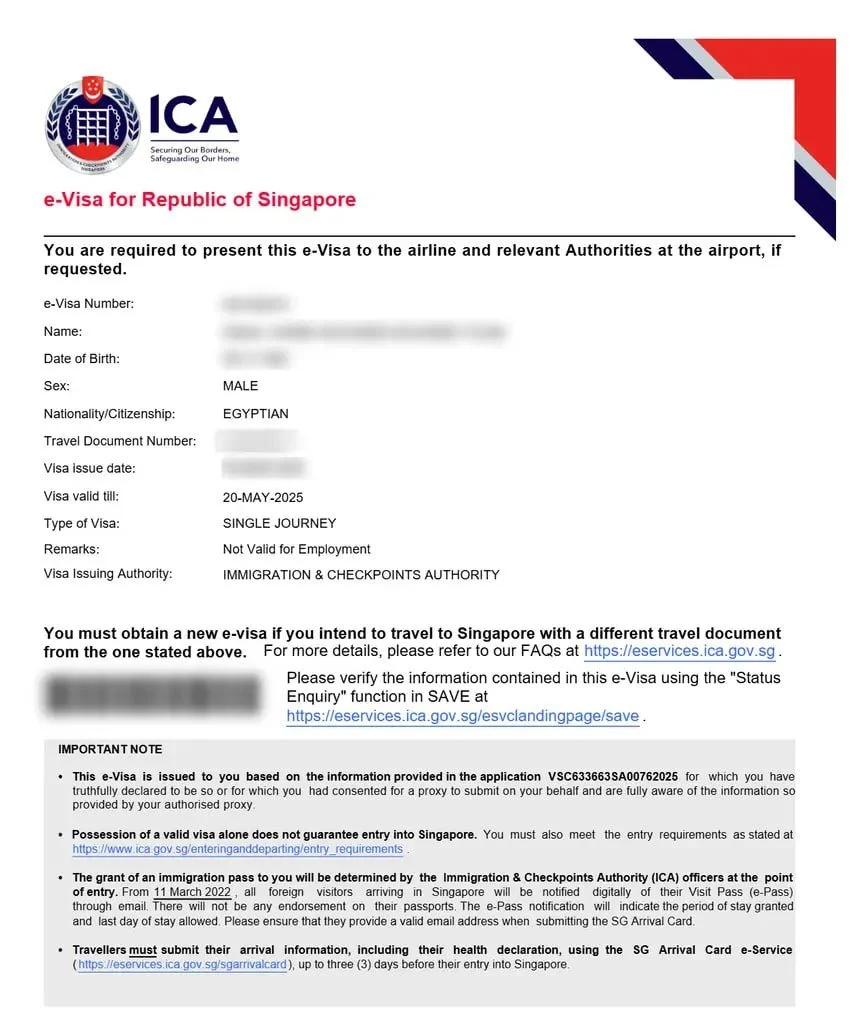
SGAC vs Visa: Side-by-Side Comparison
Understanding the Singapore Arrival Card vs visa distinction requires comparing their key attributes. The Singapore Electronic Arrival Card and a Singapore visa serve different legal and practical purposes.
| Attribute | Singapore Electronic Arrival Card (SGAC) | Singapore Visa |
|---|---|---|
| Definition | Digital entry declaration | Travel authorization |
| Purpose | Health and customs check | Entry permission |
| Legal Nature | Self-declared form | Government-adjudicated |
| Cost | Free | S$30 |
| Who Needs It | All foreign travelers | Specific nationalities |
| Validity | Single trip | Months to years |
| Submission | Online or MyICA App | Consular or e-Visa portal |
| Processing | Instant | 3 to 5 business days |
| Authority | ICA automated system | ICA or Consulate |
| Mandatory? | Yes, always | Conditional |
Apply for a visa first if required; then submit the Singapore Electronic Arrival Card (SGAC) within 3 days of arrival regardless of visa status.
When Do You Need a Visa for Singapore?
Singapore entry visa requirements depend on nationality. The Immigration & Checkpoints Authority (ICA) categorizes nationalities into three tiers:
- 90-day visa-free entry: United States, United Kingdom, European Union member states, Australia, Japan, South Korea, Canada, New Zealand, Switzerland.
- 30-day visa-free entry: Select ASEAN nations.
- Visa required: Countries needing an e-Visa or consular visa (e.g., India, China, Myanmar).
Even visa-free travelers must submit the Singapore Electronic Arrival Card before every trip. Verify your exact status using the ICA visa requirement tool (updated June 25, 2026).
Visa-Free Countries
Most Western passport holders enter Singapore visa-free for up to 90 days. The Singapore Electronic Arrival Card remains the only mandatory pre-arrival document for these travelers. Check your nationality on the ICA website before booking; lists can change.
When the SGAC Suffices: No Visa Needed
For visa-exempt nationals, the Singapore Electronic Arrival Card (SGAC) suffices as the only mandatory pre-arrival document. No fee, no approval process, no supporting documents required. Submit the SGAC online within 3 days of arrival, receive acknowledgment, then proceed through immigration. The officer determines your stay duration based on the visa-waiver allowance (30 or 90 days). This SGAC-only pathway applies exclusively to travelers already visa-exempt; all others must also obtain a Singapore visa.
Singapore Arrival Card & Visa Requirements for US Citizens (2026)
US citizens do NOT need a visa for Singapore in 2026. For a detailed walkthrough, see our Singapore Arrival Card guide for US citizens. American passport holders enter visa-free for up to 90 days. The Singapore Electronic Arrival Card (SGAC) is their only mandatory pre-arrival document.
SGAC submission for US passport holders:
- Access the ICA e-Service or MyICA Mobile App.
- Select nationality “United States”; enter passport details, flight info, accommodation.
- Complete the electronic health declaration.
- Submit and receive digital confirmation.
Passport must be valid for at least 6 months from entry date. Carry the SGAC confirmation (digital or printed) alongside your US passport and return or onward ticket.
How SGAC and Visa Work Together
The Singapore Arrival Card vs visa workflow depends on nationality. If your nationality requires a Singapore visa, apply first, wait for approval, then submit the Singapore Electronic Arrival Card within 3 days of arrival. SGAC submission is independent of visa processing.
- Check visa requirement: Verify based on passport nationality.
- Apply for a visa: Submit via the ICA e-Visa portal or embassy; pay S$30.
- Receive approval: Wait 3 to 5 business days (standard e-Visa).
- Submit the Singapore Electronic Arrival Card (SGAC): Complete within 3 days of arrival.
- Travel: Present both the approved visa and SGAC confirmation at the checkpoint.
Visa-exempt travelers skip steps 2 and 3, proceeding directly to SGAC submission.
What Happens If You Don’t Submit Your SGAC?
Airlines may deny boarding; ICA officers at the checkpoint may refuse entry. Learn more about what happens when your Singapore Arrival Card is denied.
The Singapore Electronic Arrival Card is mandatory for all foreign visitors. A valid visa does not grant an SGAC exemption. Airlines verify submission status under IATA compliance guidelines: no confirmed Singapore Electronic Arrival Card means no boarding pass. Upon landing, the Immigration & Checkpoints Authority (ICA) checks your digital record. Missing this declaration causes processing delays or immediate return. Submit the free online form within 3 days of arrival via the ICA portal.
Common Mistakes: Confusing the SGAC with a Visa
- Myth: “I hold a visa, so I do not need the SGAC.”
Fact: The Singapore Electronic Arrival Card is mandatory for all foreign visitors regardless of visa status. - Myth: “Visa-exempt travelers need nothing before arrival.”
Fact: The SGAC is the sole mandatory pre-arrival document for visa-exempt travelers. - Myth: “The SGAC costs money.”
Fact: The application is free via the ICA e-Service and MyICA Mobile App. Charging websites are third-party intermediaries, not the government. Learn how to spot Singapore Arrival Card scams and protect yourself.
Frequently Asked Questions: SGAC and Visa (2026)
Is the Singapore Arrival Card the same as a visa?
No. The SGAC is a digital health and immigration declaration required for all foreign visitors; a Singapore visa is a separate travel authorization. They are never interchangeable.
Do I need both a visa and a Singapore Arrival Card?
Depends on nationality. Visa-required nationals need both: the visa for entry permission and the SGAC for pre-arrival compliance. Visa-exempt travelers (US, EU, UK, Australia) only need the SGAC.
Is the Singapore Arrival Card free?
Yes, completely free via the ICA e-Service or MyICA Mobile App. Third-party websites that charge processing fees are not the government platform.
Do US citizens need a visa for Singapore in 2026?
No. US citizens enter visa-free for up to 90 days. The Singapore Electronic Arrival Card (SGAC) is still required before every trip.
Can I submit my SGAC before applying for a visa?
Yes. SGAC submission is independent of the visa application. Since the arrival card must be submitted within 3 days of arrival, most travelers apply for their visa first.
What happens if I don’t submit my Singapore Arrival Card?
Airlines may deny boarding; ICA officers at the checkpoint may refuse entry. The SGAC is mandatory regardless of visa status.
Key takeaways: (1) The Singapore Electronic Arrival Card is never interchangeable with a visa, (2) your need depends on nationality: always verify on the ICA website, (3) both documents can be required simultaneously and complement each other within Singapore’s immigration framework.
This information is compiled from official ICA publications and current travel advisories as of August 2026. Always verify the latest requirements directly with the Immigration & Checkpoints Authority (ICA) before travel.